Explore T-shirt embroidery machine features, uses and key specifications. Learn how to choose the right machine for creating professional embroidery designs on T-shirts and apparel.
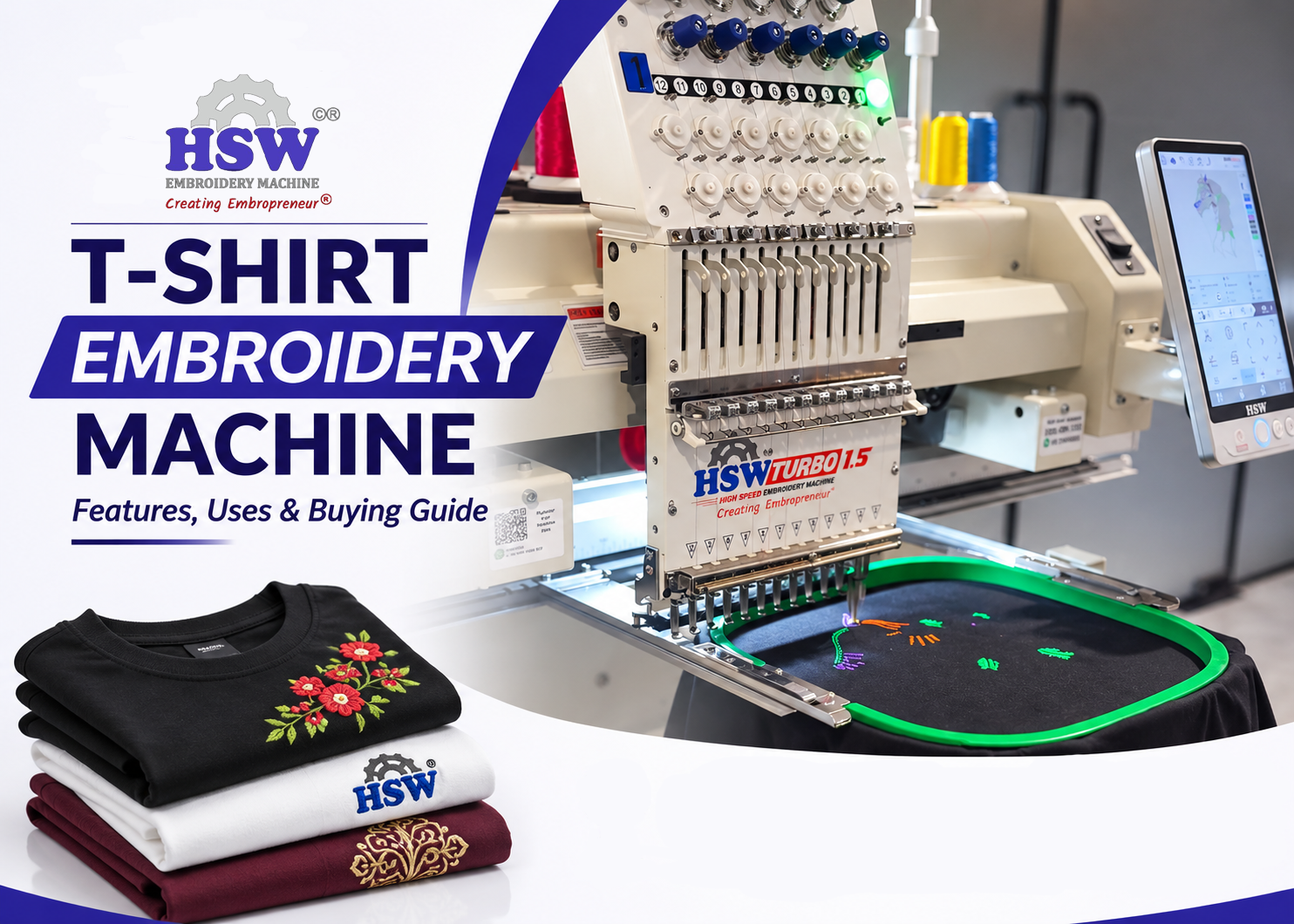
T-shirt embroidery is common in uniform manufacturing, sportswear, promotional clothing, and customised apparel.
A company may need its logo on staff T-shirts, a sports club may order embroidered team names, or a clothing brand may want a small design on the chest of every T-shirt in a collection. These orders require more than just a good embroidery design.
The machine needs to handle different garment sizes, hoop positions, and fabric types. For anyone planning to start a T-shirt embroidery business, choosing the right machine makes a noticeable difference to daily production.
What Is a T-Shirt Embroidery Machine?
A computerized T-shirt embroidery machine is used to stitch logos, names, lettering, and decorative designs directly onto T-shirts. Most commercial businesses use computerized embroidery machines for this work.
First, the design is converted into a machine-readable file, and then the T-shirt is placed in an embroidery frame. Once the design position is set, the machine follows the stitch instructions automatically.
You don't necessarily need a machine made exclusively for T-shirts. A single-head computerized embroidery machine can also handle shirts, caps, jackets, and other garments, provided the required frames and attachments are available.
What Types of T-Shirt Embroidery Work Can You Do?
T-shirt embroidery itself is a huge market in the embroidery business. It covers everything from small brand logos to large-scale commercial garment orders. Here are some common work areas for T-shirt embroidery:
-
Corporate uniforms: Company logos and employee names embroidered on staff T-shirts.
-
Sportswear: Team logos, player names and numbers for clubs and sports academies.
-
Customised clothing: Names, initials and personalised designs.
-
Promotional merchandise: Branded T-shirts for events, exhibitions and campaigns.
-
Fashion and streetwear: Chest logos, sleeve embroidery and decorative designs.
Small chest logos are among the most common commercial applications, while larger designs require more embroidery space and take longer to stitch.
Features to Look for in an Embroidery Machine for T-Shirts
-
Embroidery Area and Frame Sizes
A machine's embroidery area determines the maximum design size it can stitch in one setup. This matters when working with different T-shirt designs.
For example, a small logo on the left chest needs less space than a large design across the front. Check the available frame sizes and how easily different T-shirt sizes fit in the frame before purchasing.
-
Needle Configuration
Multi-needle machines allow several thread colours to remain loaded; for example, a 12-needle embroidery machine can handle a multi-colour design without requiring the operator to change the upper thread manually after every colour.
This is useful for multicolour company logos and designs, particularly when producing several garments with the same artwork.
-
Stitching Speed
Machine speed is another specification worth checking. Faster machines help with regular production, but the maximum speed does not tell you how quickly every design will be completed.
A simple logo and a dense design with several colour changes have different stitching times.
The machine should also maintain good stitch quality while running at higher speeds.
-
Touchscreen and Design Transfer
Check the screen controls and supported embroidery file formats. A computerized T-shirt embroidery machine should make it convenient to load designs, select colours, and monitor stitching.
Also ask how designs are transferred to the machine, whether through USB, Wi-Fi, or another supported method.
-
Service and Training
A new operator needs to learn hooping, thread tension, stabilizer selection, and basic machine operation. These things affect the finished embroidery just as much as the machine itself.
Before buying, ask about installation, training, spare parts, and technical support. These become particularly important when you have customer orders to complete.
How to Embroider on a T-Shirt
T-shirts are usually made from knitted fabric, which stretches more easily than materials such as denim or canvas. This is why hooping and stabilizer selection need attention.
The design is digitized and saved in a machine-supported format.
A suitable stabilizer is placed behind the T-shirt. A lightweight cut-away or adhesive tear-away stabilizer is mostly used, depending on the fabric and design. For small lettering or textured surfaces, a water-soluble topping may also help.
Then, it is hooped. The garment should sit flat in the hoop without being stretched out of shape. Once the design is positioned, the operator can run the embroidery.
Remember, for bulk orders, getting the placement right is especially important. If the logo sits too high or too low on the first T-shirt, repeating that position across the entire order will create the same problem on every garment. A sample stitch before production helps catch these issues.
Choosing the Best Embroidery Machine for a T-Shirt Business
The right T-shirt embroidery machine depends on the kind of orders you plan to take.
A single-head machine can be a practical starting point for personalised T-shirts and small logo orders. It also gives you more flexibility when T-shirt orders are slow, as it can be used for other embroidery work.
A multi-needle setup saves time on thread changes for regular multicolour work. If you expect larger designs or different garment styles, pay attention to the embroidery area and available frames.
Don't calculate your investment using only the machine price. You will also need threads, stabilizers, needles, hoops, digitizing, and operator training. These costs are part of running an embroidery business.
HSW Embroidery Machines for T-Shirt Work
At HSW, we offer single-head computerized embroidery machines for businesses working with customised garments, including T-shirt embroidery.
Our range includes three models:
-
HSW Neo: An entry-level option for those starting an embroidery business.
-
HSW Ultra: A 1200 RPM machine for regular embroidery work.
-
HSW Turbo 1.5: A 1500 RPM model designed for higher-speed production.
Our machines feature a 12-needle configuration, allowing multiple thread colors to be used in a design. If you are considering one for T-shirt embroidery, we offer different frame sizes compatible with your chosen model. We also provide full support and a training demonstration using a T-shirt so you can see how the garment is positioned and how the machine handles the design.
Beyond T-shirts, our computerized embroidery machines can also be converted into an aari embroidery machine or bead embroidery machine using the right digitized files and attachment devices. This provides you with the flexibility to embroider on caps, shoes, blouses, and more.
Starting a T-Shirt Embroidery Business
No need to depend only on individual T-shirt orders. Companies, schools, sports clubs, event organisers, and clothing brands can all need embroidered garments.
Orders for a T-shirt embroidery business vary in quantity: one day you might have a few customized orders, while another day could bring a larger uniform order. Therefore, your machine should be capable of handling the type of work required.
Paying attention to stitching, logo placement, and finishing on every T-shirt in detail helps bring the same customer back with more orders.
About the Author

Mr. Tapan Kapadia is the Founder and Director of HSW, a pioneer in accessible single-head commercial embroidery machines. With over three decades of textile industry experience, he has empowered tens of thousands of home entrepreneurs and small businesses across India.