Learn what an Aari embroidery machine is, how it works, its key features, uses and what to consider when choosing the right machine for your embroidery business.
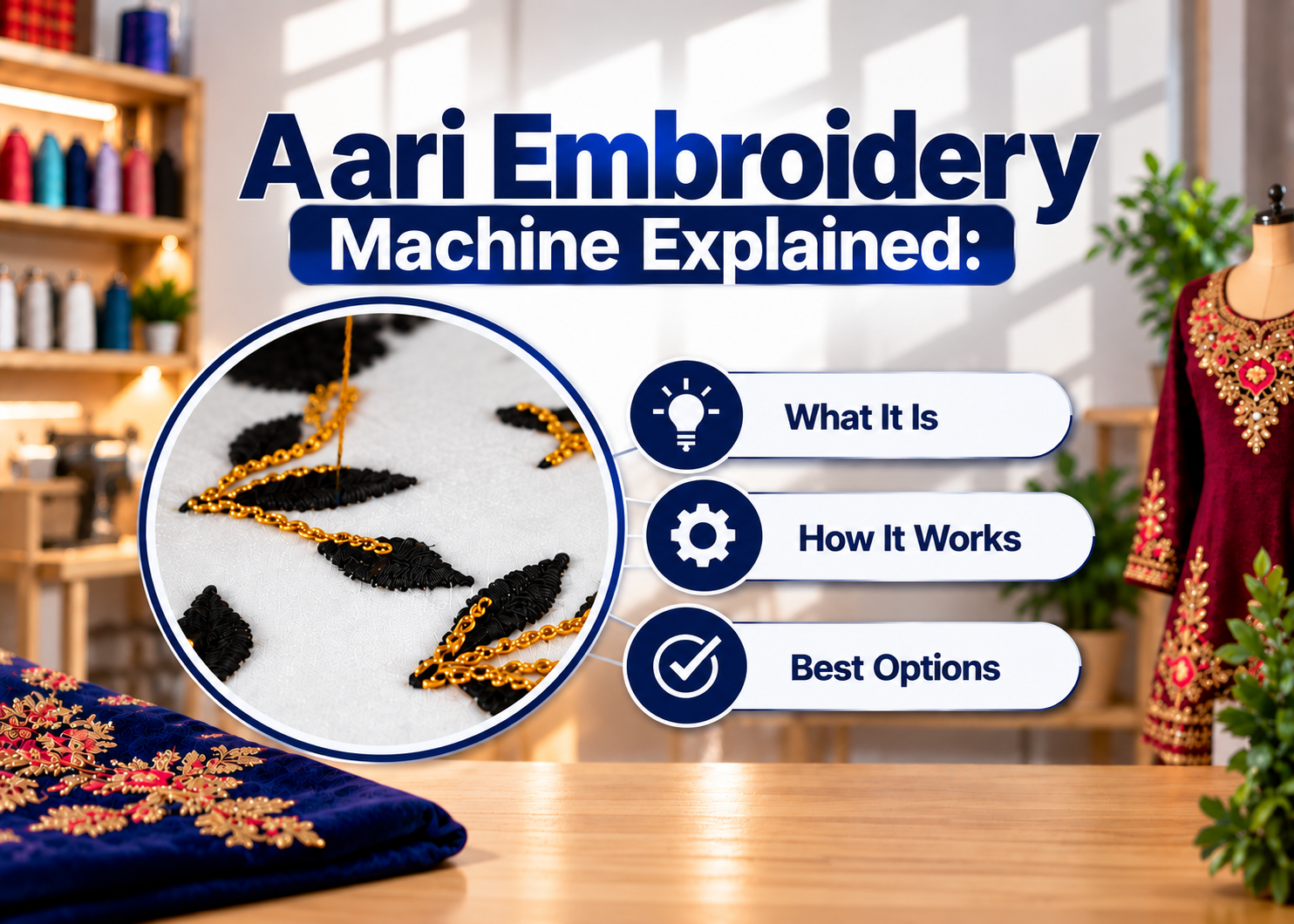
Aari work has always had a strong place in Indian fashion. You will find some form of Aari embroidery on a bridal blouse, a heavily worked lehenga, or a wedding saree.
Traditionally, this work is done by hand. The artisan uses a hooked needle to create the embroidery, one stitch at a time. It looks beautiful, but detailed work can take a lot of time.
Now, embroidery machines that can do Aari-style embroidery have changed the way many embroidery businesses approach production. But an Aari machine isn't simply a faster version of the handwork. The way the work is prepared and produced is different.
So, what exactly is an Aari embroidery machine?
An Aari work embroidery machine is a computerized embroidery machine designed to create Aari-style patterns on fabric.
The design is first prepared digitally, then loaded into the machine. After the fabric is fixed in place and the machine is set up, the machine follows the programmed design to produce the embroidery.
How to Use an Embroidery Machine the Right Way?
The machine doesn't start with a piece of fabric and magically create a finished design. There is some preparation involved.
-
First, A digital embroidery file has to be created or selected. The design file should be suitable for the fabric and the type of finish you want.
-
Next, the fabric needs to be prepared and fixed properly. The thread is loaded, machine settings are checked, and the design is started. Once this process begins, the machine takes care of the programmed movements.
-
The operator still needs to monitor the work. Issues such as Thread breaks, fabric movement, needle issues, and other small problems can affect the embroidery if they are not noticed in time.
So while the Aari work embroidery machine reduces a lot of manual work, it doesn't remove the need for someone who understands embroidery.
Why choose a machine instead of doing Aari work by hand?
Hand embroidery can make complete sense for a single customised garment. But the situation changes when the same type of work needs to be repeatedly produced.
Imagine a boutique receives an order for 25 blouses with a similar Aari design. Getting every blouse done by hand takes time and depends on the availability of skilled artisans.
The real attraction for a business: a machine can run the same digital design on multiple pieces. It isn't just about speed, but also about being able to repeat a design without starting the embroidery from zero every time. This can make production easier to plan for businesses with regular orders.
Where is machine Aari work commonly used?
The Automatic Aari Work Machine is particularly popular in garments where decorative work is a major part of the design. Blouses are an obvious example. But the work isn't limited to blouses.
Depending on the machine and its working area, it can be used for designs on sarees, lehengas, bridal outfits, kurtis, and other fashion garments.
The kind of customer you want to serve should therefore come into the picture before you buy a machine. Working mainly with blouse designers may need a different setup from a garment manufacturer producing larger quantities.
What does “computerised Aari embroidery machine” mean?
A computerised Aari embroidery machine is one where the embroidery pattern is controlled through a computerised system.
Instead of manually guiding the needle through the complete design, the operator works with a digital embroidery file and the machine follows it.
The quality of the finished work still depends on several practical factors, including the design file, fabric, thread, machine settings, and how well the machine is maintained.
A computerized machine can make production more repeatable, but it cannot fix a poorly prepared design or badly set-up fabric.
What should you look for when buying an Aari machine?
Think about your actual orders. How large are the designs? What fabrics are you working with? Are you doing mostly blouses and ethnic wear, or do you want to take different types of embroidery orders? How many pieces do you expect to produce in a day?
Then look at the machine's embroidery area, speed, controls and overall construction. Service is another thing that is easy to overlook when comparing machines. It becomes much more important after the machine is installed. If a production machine stops mid-order, getting technical help quickly matters.
Training also helps, especially if this is your first computerized embroidery machine.
Is a machine the same as traditional Aari embroidery?
The look and technique may be based on Aari embroidery, but the production process is different.
Hand Aari work gives an artisan direct control over every part of the embroidery. Machine work follows a digital design and is better suited to repeating the same pattern across multiple pieces.
Both have their place; handwork may still be preferred for one-off, highly personalised pieces, while a machine can make the workload much easier for businesses dealing with regular production.
How to Choose the Right Machine
There isn't much point in choosing an Aari machine simply because it has the highest speed or the longest list of features. Start with the work.
If your business is going to focus on detailed blouse work, look at machines that suit that kind of garment. If you expect larger or more regular orders, production capacity becomes more important.
And if you're investing in a machine for a business, don't separate the machine from the support that comes with it. Installation, training, servicing, and spare parts can all become part of your day-to-day experience with the machine.
An Aari machine is ultimately a production tool. The right choice is the one that fits the work you expect to put through it.
About the Author
Mr. Tapan Kapadia is the Founder and Director of HSW, a pioneer in accessible single-head commercial embroidery machines. With over three decades of textile industry experience, he has empowered tens of thousands of home entrepreneurs and small businesses across India.